

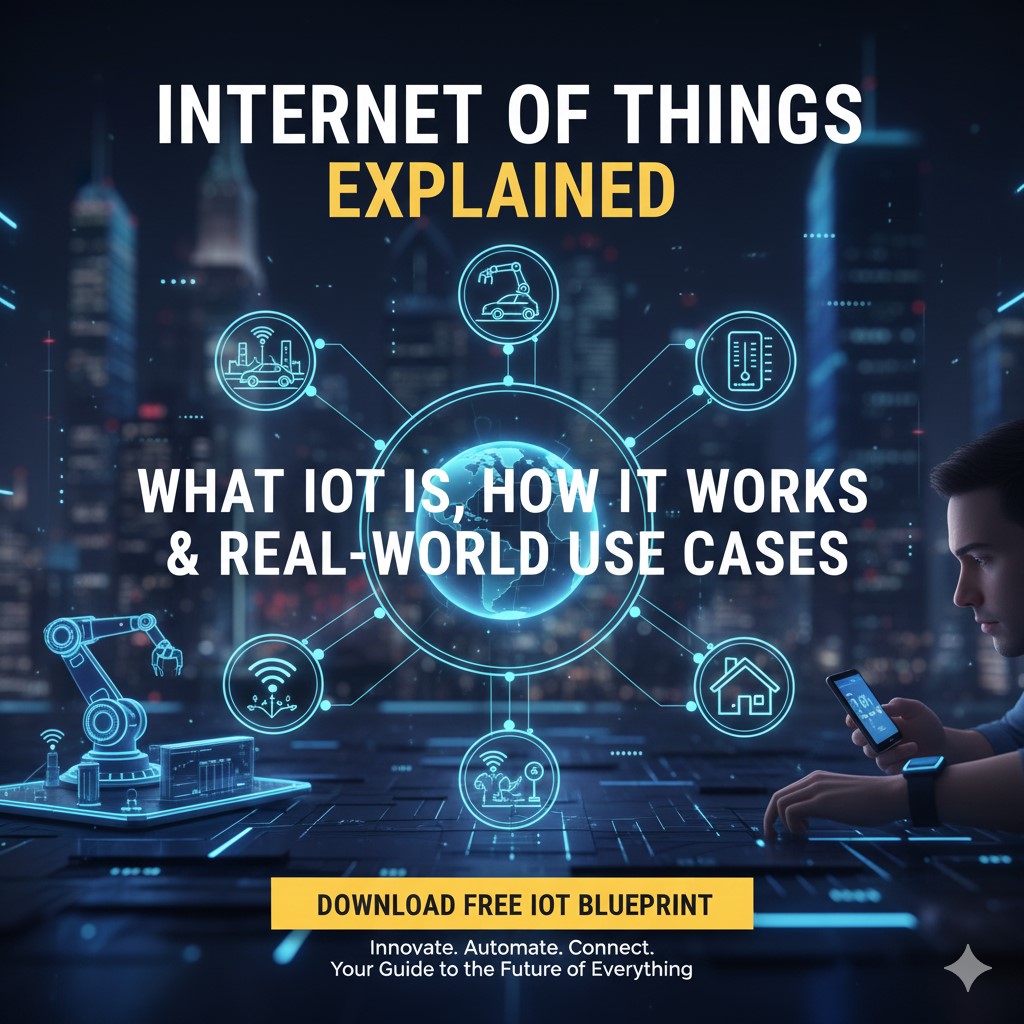
The Internet of Things, or IoT, connects ordinary objects to the internet. Sensors, chips, and networks let devices speak. They send data. That data becomes insight. Insight becomes action.
Think of IoT like a network of tiny sensors. Each one watches something. Temperature. Motion. Vibration. Heart rate. A smart thermostat senses a room. It talks to a cloud service. The service learns your habits. The thermostat changes the temperature automatically. Simple. Powerful.
So how does IoT work at a basic level? Devices collect data and send it to gateways. Gateways aggregate data and push it to the cloud or an edge node. Cloud services store and analyze data. Dashboards or apps show results. Rules or machine learning models trigger actions. That chain—device, gateway, cloud, app—is the backbone of modern IoT systems.
IoT definition, core components, and protocols
At its core, IoT has three parts: sensors and actuators, connectivity, and analytics. Sensors measure physical things. Actuators make changes. Connectivity moves the data. Analytics turns the data into value.
Common IoT protocols include MQTT, CoAP, and HTTP/REST. For low-power wide-area networks, systems use LoRaWAN or NB-IoT. In industrial settings, protocols like OPC-UA and Modbus still matter. Security layers rely on TLS, PKI, and OAuth for device identity and encryption.
Edge computing reduces latency. Instead of sending every event to the cloud, some processing happens on the gateway or edge node. That helps in real-time cases like factory automation or autonomous drones.
Think of protocols as languages. MQTT is short and fast. It suits telemetry and resource-constrained devices. CoAP mirrors RESTful principles for low-power devices. Choose the right protocol for the task.
Difference between IoT and Industrial IoT (IIoT)
IoT often refers to consumer and commercial devices. It covers smart homes, wearables, and city sensors. IIoT focuses on industrial systems. It targets factories, energy grids, and logistics.
The main differences are scale, reliability, and safety. IIoT demands deterministic latency, higher uptime, and stronger integration with control systems. It uses industrial protocols and stricter security. In IIoT, failure can mean production loss or physical harm. So the stakes are higher.
In short: IoT improves daily life. IIoT optimizes industrial processes and critical assets.
Practical IoT use cases
Smart cities use IoT to make life smoother. Sensors track traffic flow. Street lights dim when no one is nearby. Waste bins report fullness so trucks route efficiently. The result is less congestion and lower costs.
Smart buildings use IoT for energy management. Occupancy sensors adjust HVAC. Smart windows and lighting cut energy use. These systems rely on interoperable standards and secure device onboarding. The return on investment shows in lower bills and happier occupants.
A simple example: parking sensors that show free spots on an app. Drivers save time. Cities reduce emissions. Small change. Big impact.
IoT in industrial automation and predictive maintenance
Factories deploy sensor networks for predictive maintenance. Vibration sensors on motors pick up early signs of failure. Temperature sensors spot overheating. Machine learning models predict when a part will fail.
This approach cuts downtime. It lowers repair costs. It extends asset life. It also reduces unexpected production loss.
IIoT integrates with PLCs and SCADA. It streams telemetry to edge analytics or cloud platforms. The model then issues maintenance work orders, or it triggers automatic shutdowns to avoid damage.
IoT in agriculture
Smart agriculture uses soil moisture sensors, weather stations, and drones. Farmers measure soil moisture and crop stress. They then apply irrigation or fertilizer precisely.
Precision farming increases yields and saves water. That matters in drought-prone regions. Simple sensors plus analytics turn raw soil data into irrigation schedules.
A farmer I know installed soil sensors across a field. The system cut water use by 30 percent. Yields stayed the same. Costs dropped. The technology paid for itself within a season.
Top IoT examples for Smart Homes
Connected home devices include thermostats, cameras, smart locks, and voice assistants. They use Wi-Fi, Zigbee, or Thread for local connectivity. These devices integrate into platforms that manage routines and automations.
Smart buildings scale the same idea. They link access control, energy, and security. Centralized building management systems allow remote monitoring and predictive maintenance. The benefits are lower energy bills and improved occupant comfort.
Real IoT deployments in manufacturing and logistics
IoT in logistics tracks pallets using RFID and GPS. Telemetry from trucks monitors fuel use and route efficiency. Warehouses use sensors for inventory visibility and robot coordination.
In manufacturing, digital twin examples driven by IoT sensor networks create virtual replicas of production lines. These twins simulate changes, test optimizations, and reduce commissioning time.
Real deployments require careful planning. Start small. Validate a pilot. Then scale with proven templates.
IoT in healthcare and medical monitoring
IoT healthcare use cases focus on remote patient monitoring and chronic disease management. Wearables collect heart rate, activity, and sleep. Devices feed data to clinicians for early intervention.
Remote patient monitoring systems flag declines in vitals. Care teams intervene sooner. That reduces hospital readmissions. Telemedicine integrates with IoT devices to enable virtual exams and better follow-ups.
IoT solutions for telemedicine include connected blood pressure cuffs and pulse oximeters. They provide clinicians with continuous, accurate data. That supports personalized patient care systems and improves outcomes.
Connectivity and technology trends: 5G, edge, and AIoT
5G enables higher throughput and lower latency. It supports dense device deployments in cities and hospitals. Edge computing complements 5G by processing data close to the source.
AIoT—AI plus IoT—adds intelligence at the edge. Devices can run models locally to trigger fast actions. For example, a camera running a vision model can flag safety hazards instantly.
Blockchain can strengthen device authentication and tamper-proof logs. It helps secure device identity and supply chain provenance. Digital twins combine sensor data with simulation to predict behavior and optimize systems.
These trends shift IoT from passive sensing to active automation and closed-loop control.
Security, privacy, and standards for IoT
Security must be baked in from day one. Start with secure boot and strong device identity. Use firmware over-the-air updates securely. Encrypt data in transit and at rest. Use TLS and validate certificates.
Common IoT cybersecurity best practices include device provisioning, least privilege, and zero trust principles. Protect APIs and enforce rate limits. Monitor logs centrally with SIEM tools and anomaly detection.
Privacy is crucial in IoT health and personal data. Apply data minimization and consent models. Use DSPM and data classification to map sensitive records.
Interoperability relies on standards. Support standard protocols and implement open APIs. Use industry standards like MQTT for telemetry and OPC-UA in industrial contexts.
Industry-specific considerations: smart home, IIoT, enterprise
Smart home devices focus on ease of use and energy management. They need secure onboarding and voice control integration. Enterprise IoT deployments require scale, governance, and integration with existing IT systems. IIoT projects require ruggedized hardware and industrial protocol support.
In logistics and manufacturing, pay attention to network segmentation, OT/IT convergence, and change control. In healthcare, validate device accuracy and comply with HIPAA and medical device rules.
Future and sustainability: green IoT and 2026 trends
Future IoT trends include more efficient sensors and smarter edge models. IoT sustainability solutions help monitor water usage, energy grids, and soil health. Smart grids use IoT to balance supply and demand and integrate renewable energy.
Predictions for 2026 show more federated learning for privacy, wider 5G adoption, and deeper AIoT at the edge. Expect better standardization and stronger security baselines.
How to plan your IoT project?
Start with clear objectives and measurable KPIs. Identify sensors, connectivity, and cloud or edge needs. Prototype one use case. Test data quality and security. Validate integration with existing systems. Scale with templates and governance controls.
A simple plan:
- Define the business problem.
- Choose sensors and protocols.
- Secure devices and data.
- Build the analytics pipeline.
- Pilot and measure.
- Iterate and scale.
Final thoughts and next steps
IoT connects data to action. It brings efficiency, safety, and new services. From smart homes to industrial automation and healthcare monitoring, IoT transforms how we manage assets and deliver care.
Start with a small pilot. Focus on security and standards. Use edge computing and AIoT to reduce latency. For industrial projects, prioritize IIoT patterns and protocol support. Measure outcomes. Use digital twins to test changes before you deploy.
If you want, I can turn this into a 6-part blog series or create meta tags and SEO briefs for each section. Tell me which use case you want to pilot first, and I will draft a one-page plan.