

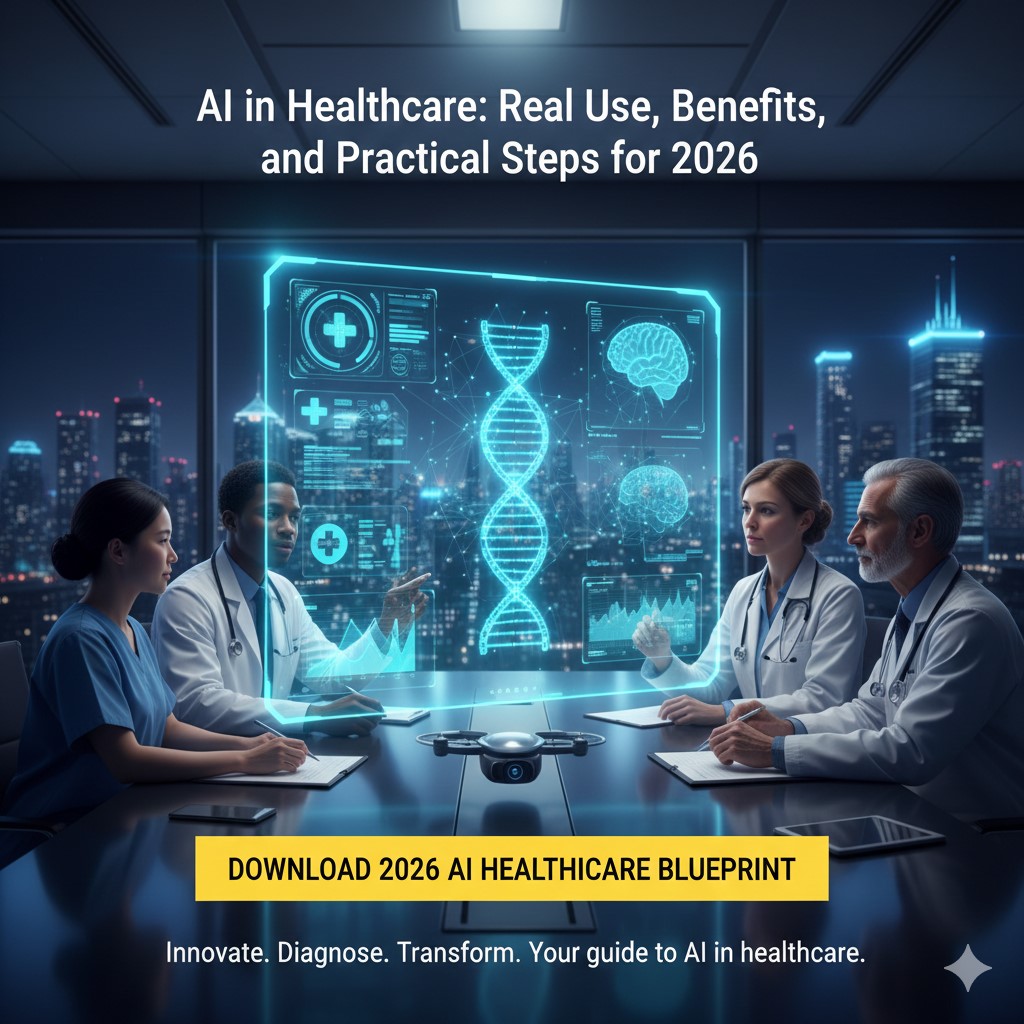
AI in healthcare is no longer a lab experiment. It is part of everyday care in many hospitals and clinics. From image analysis to clinical decision support systems, AI helps clinicians make faster and better choices. The result? Better patient outcomes, fewer errors, and more efficient workflows.
This post walks through real-world AI healthcare applications examples and practical AI use cases in hospitals and clinics. It explains how AI healthcare solutions improve patient outcomes. It highlights AI healthcare case studies in disease detection and the benefits of AI enabled clinical decision support systems.
Real-world AI healthcare applications you can use today
Hospitals and clinics deploy AI in many places now. Imaging is the most visible. Radiology uses AI imaging tools that improve MRI and CT scan interpretation. Deep learning models spot tiny tumors early. They find nodules that human readers might miss.
Beyond imaging, AI helps with records. Natural language processing for medical records extracts structured facts from free text. That makes EHR data searchable and actionable. With NLP, clinical decision support systems feed on clearer inputs.
Telemedicine also benefits. AI driven telemedicine tools screen symptoms and route patients to the right care. AI chatbots handle follow-ups and medication reminders. Small clinics use affordable AI medical tools for scheduling and triage.
These examples show how practical AI use cases in hospitals and clinics can scale fast. They show AI healthcare solutions for improving patient outcomes across the care pathway.
Benefits of AI in medical diagnosis
AI improves diagnostic accuracy. It reduces human error and speeds detection. In radiology and pathology, AI diagnosis benefits are clear. Algorithms highlight suspicious regions on scans and slides. That helps radiologists and pathologists focus on the most urgent cases.
AI tools that help detect cancer earlier than traditional methods now exist. Some models identify tiny lesions on CT and MRI. Others find suspicious cells in pathology slides. Early detection raises survival chances. Early detection saves costs and reduces invasive procedures.
AI assisted disease detection in early stages gives clinicians a head start. The technology flags probable cases for quicker review. It does not replace doctors. It supports them. That combination reduces diagnostic errors and improves outcomes.
Machine learning for disease prediction
Machine learning models for predicting chronic diseases are changing care. ML disease risk forecasting uses labs, vitals, medications, and social data. It predicts heart disease risk from patient data. It forecasts diabetes progression and the chance of hospital readmission.
These models help preventive care. They highlight patients who need outreach. They allow targeted interventions before crises. In primary care, ML predictive analytics in healthcare outcomes guides care plans and resource allocation.
Models vary. Some use logistic regression. Others use gradient boosted trees or neural nets. The key is validation. Test models on external cohorts before use. And check for bias across patient groups.
How AI helps radiology imaging — examples and impact
AI radiology imaging examples for early tumor detection are growing. Convolutional neural networks analyze pixels and patterns at scale. They help interpret MRI and CT scans faster. They also assist X-ray and ultrasound diagnostics.
AI powered X-ray and ultrasound diagnostics benefits include faster reads and fewer missed fractures. AI radiology workflow automation speeds reporting. It prioritizes critical scans for immediate review. That improves patient flow and reduces waiting times.
But deployment needs care. Validate AI models locally. Monitor performance. Make sure AI integrates with PACS and the radiology reporting workflow.
Deep learning in healthcare
Deep learning healthcare applications in diagnostics shine where large labeled datasets exist. Deep neural networks analyze imaging, waveform, and continuous monitoring data. They detect retinal disease, classify skin lesions, and predict deterioration.
A deep learning cancer detection model case study might show a model that improves early detection rates for lung nodules. That model can run alongside radiologists to increase sensitivity.
Still, deep learning models can be opaque. Use explainability tools. Combine model outputs with clinician review. That keeps safety high and trust strong.
NLP for medical records
Natural language processing to automate medical charting saves time. NLP for extracting clinical insights from patient records turns messy text into structured data. It finds diagnoses, meds, and allergies. It also flags drug interactions from clinical text.
NLP powers clinical decision support systems benefits by feeding accurate, machine-readable info. That makes CDS more reliable and timely. Use clinical embeddings, named entity recognition, and negation detection for best results.
Telemedicine with AI
AI healthcare use cases for telemedicine include remote diagnosis and follow-ups. AI telehealth symptom triage systems evaluate urgency and route patients correctly. That reduces ER visits and helps clinics scale.
AI chatbot use cases in telemedicine patient care handle simple triage and admin tasks. They free clinicians to focus on complex cases. For chronic disease management, AI telemedicine solutions offer monitoring and personalized advice.
AI tools for symptom analysis
AI symptom assessment tools for patient triage ask targeted questions. They use clinical decision rules to suggest next steps. They help primary care providers prioritize cases.
Good tools integrate with EHRs. They log triage outcomes. They help clinics reduce wait times and improve care quality.
What is AI in healthcare Benefits?
AI brings several clear benefits. It speeds diagnosis. It improves monitoring. It reduces preventable errors. It supports clinical decision-making.
For patients, AI can mean earlier treatment and fewer missed conditions. For clinicians, AI can mean less administrative work and faster case prioritization. For systems, AI can mean better resource use and lower costs.
AI medical tools for small clinics
Small clinics can adopt cheap, effective AI tools. Symptom checkers help triage. Cloud-based imaging aids basic diagnostics. Telehealth platforms improve reach.
The key is integration. Pick AI tools that work with your EHR and protect patient data. Start with pilots and measure outcomes.
Trends to watch in 2026 and beyond
AI healthcare trends in 2026 point toward explainability, privacy, and federated learning. Expect models that share learnings without sharing raw data. Expect more wearable-driven monitoring and smarter DSPM for health data protection.
Regulatory guidance will also play a bigger role. Hospitals will prioritize validated models and transparent performance metrics.
Examples of AI in patient monitoring
AI remote patient monitoring systems use wearables for continuous tracking. They detect heart rhythm issues, oxygen drops, and activity decline. Remote monitoring helps manage chronic conditions and avoids readmissions.
Deep learning predictive models in patient monitoring can pick up early signs of deterioration. That leads to faster interventions and better outcomes.
AI Assisted diagnosis tools list: what clinicians need
Clinicians should look for validated tools. Imaging AI for radiology and pathology is common. Clinical decision support systems that integrate with the EHR are valuable. Symptom checkers and predictive analytics tools also add value.
Compare by accuracy, clinical validation, and integration options. Check peer-reviewed studies and local pilots.
How machine learning improves patient care in practice
Machine learning enhances personalized patient care. It tailors treatment plans and predicts who will respond to therapy. ML models optimize scheduling and cut no-shows. They identify patients who need extra follow-up.
That leads to better outcomes and smarter resource use.
AI ethics in healthcare explained: fairness and safety
AI ethics in healthcare explained must start with bias checks. Test models across demographics. Protect privacy and ensure proper consent. Be transparent about model limits and performance.
Involve clinicians in design. Publish validation and monitor post-deployment outcomes. Ethical practice builds trust and supports real adoption.
Impact of AI on telehealth services: scale and quality
AI impact on telehealth services includes wider access and smarter workflows. AI tools expand care to remote areas. They automate repeatable tasks and improve follow-ups.
Measure impact by access, satisfaction, and clinical outcomes. Use AI to augment telehealth, not to cut clinical oversight.
Quick anecdote: start small, prove value
I worked with a clinic that added an AI symptom triage tool. We ran a six-week pilot. ER referrals fell. Nurse workload dropped. Patient satisfaction rose.
The secret was clear goals and tight metrics. Start small. Measure outcomes. Scale what works.
Final thoughts
AI in healthcare is already shaping how care is delivered every day. It helps doctors spot disease earlier, supports safer decisions, and reduces pressure on busy teams. From radiology imaging and clinical decision support systems to telemedicine and patient monitoring, AI is now part of routine care, not future theory.
But success depends on how it is used. AI works best when it supports clinicians, not replaces them. Models must be tested, monitored, and updated. Data quality matters. So does privacy, fairness, and transparency. A tool that performs well in one hospital may not behave the same in another.
The smart approach is simple. Start small. Choose clear use cases. Measure real outcomes like accuracy, time saved, and patient satisfaction. When AI is deployed with care and clinical oversight, it becomes a reliable partner in improving patient outcomes and strengthening modern healthcare systems.